

What Leather Is Best for a Durable B-3 Aviator Jacket?
For a durable B-3 aviator jacket, the best shell leather is a thick, full-grain or top-grain hide, with heavy cowhide or well-finished sheepskin as the strongest practical choices. Cowhide gives the most abrasion resistance and holds its shape under the weight of a full shearling lining, while sheepskin is lighter, softer, and naturally bonded to the wool, which makes it comfortable and warm but less rugged. Thin lambskin, corrected-grain leather, and bonded materials are the weak points. The grade and finish matter as much as the animal the hide came from. If you want to see real B-3 styles while you read, browse the aviator leather jacket collection and check the leather details on each product page.
This guide explains the two ways a B-3 is built, compares the leathers used for the shell, covers grade and finish, shows what to check before you buy, and explains how to look after the leather so it lasts.
First, Understand How a B-3 Is Built
A B-3 has two layers, and which leather matters depends on how it is made.
Construction 1: Double-Faced Sheepskin
The shell and the lining are the two sides of the same sheepskin. The skin side is finished as the outer surface (smooth, waxed, or suede), and the wool side is the lining. This is the traditional shearling construction. Durability depends on the sheepskin's thickness, quality, and finish.
Construction 2: Separate Leather Shell With Shearling Lining
A leather shell, often cowhide or lambskin, is made separately, and a shearling lining is attached inside. Here you can choose a tougher shell hide than sheepskin, which is why some buyers prefer it for durability. Shearling Jackets Store's collection copy describes its B3 jackets as having a robust leather outer shell, described as top-grade cowhide or lambskin, over a sheepskin lining, so check each product page for the exact shell and construction.
Either way, the shell has to protect the lining, carry its weight, and hold up to wind, friction, and weather. For a broader look at how the design works, our guide to what an aviator jacket is covers the history and key features.
The Leathers Compared
| Leather | Durability | Weight and feel | Weather resistance | Notes for a B-3 |
|---|---|---|---|---|
| Cowhide | Highest | Heavy, stiff at first, softens with wear | Moderate, improves with waxed or treated finishes | Best choice for a tough, long-lasting shell |
| Sheepskin (as shell) | Moderate to good | Lighter, softer, more flexible | Moderate, better with waxed finishes | Comfortable and warm, less abrasion resistant |
| Goatskin | Mid to high | Light but tough, pebbled grain | Naturally higher | A strong middle ground, less common in B-3s |
| Lambskin | Lowest of these | Very soft and light | Low | Comfortable, more delicate under friction |
| Suede (split sheepskin or cowhide) | Lower | Soft, napped | Low, dislikes water | Looks great, needs more careful care |
Treat this as a general comparison. Thickness, grade, and finish can make one hide behave very differently from another. Our comparison of cowhide, lambskin, and goatskin goes deeper on how each one behaves.
Why Cowhide Is the Durability Benchmark
Cowhide comes from larger, thicker hides, so it resists abrasion and tearing better than lighter skins. In a B-3, that thickness helps in three ways:
- It carries the weight. A full shearling lining is heavy, and a sturdy shell holds its shape without sagging.
- It resists wear at stress points. Collars, cuffs, elbows, and underarms see the most friction.
- It handles weather better. A thick shell blocks wind and light moisture.
The trade-offs are weight and stiffness when the jacket is new. A cowhide-shell B-3 takes longer to break in, but it often ages well.
Sheepskin as the Shell: Comfort With Limits
When the shell is the skin side of the sheepskin, the jacket is naturally integrated and flexible. It tends to be more comfortable and drapes more softly than a heavy cowhide shell. Sheepskin shells are warm and, with a protective finish such as wax, can hold up well in normal use.
The limits are that sheepskin is generally less abrasion resistant than cowhide, and suede-faced versions mark and stain more easily. Neither is a flaw, only a reason to match the hide to how you will use the jacket. If you walk in rough conditions or carry heavy bags, a thicker shell is the safer choice.
Grade Matters as Much as the Animal
The grade tells you which part of the hide was used, and it is one of the strongest predictors of durability.
| Grade | What it means | Durability |
|---|---|---|
| Full-grain | Outer layer, natural grain intact | Highest |
| Top-grain | Outer layer, lightly sanded | High |
| Corrected or genuine leather | Often lower layers, sanded and coated | Moderate to low |
| Bonded leather | Shredded scraps and binder | Lowest |
For a durable B-3, look for full-grain or top-grain. Corrected-grain and bonded materials are more prone to cracking and peeling. Our guide to leather grades explained decodes the labels, and the explainer on full-grain leather shows why that grade is the benchmark.
Finish Changes How the Leather Ages and Resists Weather
The finish is the treatment applied to the surface, and it affects both look and durability.
- Pigmented (protected) finish: a surface coating that resists stains and light moisture. It is the most practical for daily wear, with less patina.
- Aniline or semi-aniline finish: shows more natural grain and ages beautifully, but it is more vulnerable to stains and sun.
- Waxed or oil-treated finish: adds some water resistance and a rugged, worn-in look.
- Suede or nubuck: soft and textured, but needs more careful care.
For a B-3 that you will wear in real winter weather, a protective or waxed finish on a thick shell is a practical combination.
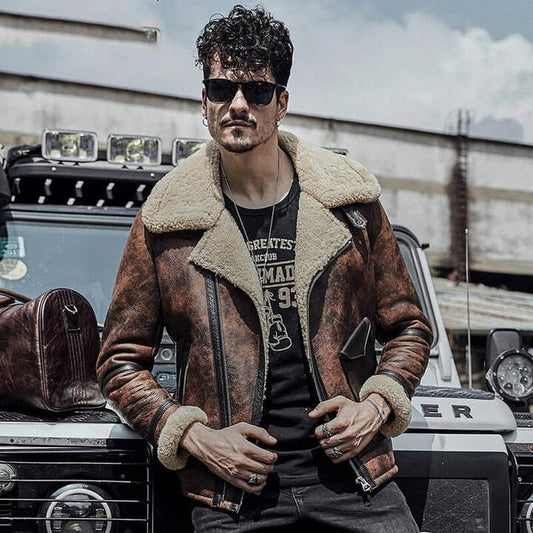
A waxed B3 like this one shows how a treated finish gives the shell a rugged character. Check the product page for the exact leather and finish.
Thickness, Tanning, and Construction
Three more factors affect how long the shell lasts:
- Thickness. A thicker hide resists abrasion better, but it is heavier. Thickness is rarely printed on a label, so look for sellers who describe the leather clearly.
- Tanning. Chrome tanning produces a softer, more flexible leather, while vegetable tanning tends to produce a firmer one that develops patina. Neither is universally better, but a well-tanned hide of either kind lasts longer than a poorly tanned one.
- Construction. Even stitching, reinforced stress points, and solid hardware matter as much as the hide. Our guide on what makes a genuine leather jacket last for years explains how these factors work together.
What to Avoid
- Bonded or heavily corrected leather. It is more likely to crack or peel.
- Very thin shells. They wear through at stress points and may sag under the lining.
- Vague descriptions. "Premium material" or "leather look" with no hide named is a reason to ask questions.
- Faux linings on a real shell, or the reverse, if you did not expect it. The shell and lining are separate questions.
- A very low price for a jacket claiming a thick, full-grain shell and real shearling.
The Lining Protects the Shell, and Vice Versa
A durable B-3 needs both parts to be sound. A real shearling lining insulates and breathes, while the shell protects it from wind and wear. If the lining is faux, the jacket behaves differently, and the shell has to work harder against moisture buildup. Shearling Jackets Store's collection pages describe a range that includes real and faux wool shearling linings, so read each product page. Our guide to the difference between genuine and faux shearling jackets shows how to tell them apart.

A classic B3 shows the traditional layout with a full lining and large collar. Check the product page for the shell leather and how the lining is constructed.
How to Inspect the Shell Before You Buy
When you handle the jacket, or when it arrives, check:
- Feel the thickness. The leather should feel substantial, not papery.
- Look at the grain. Natural variation suggests a higher grade, while a perfectly uniform printed pattern may be corrected.
- Check the finish. It should look even and natural, without a plastic-like coating.
- Bend a sleeve or collar gently. Good leather creases softly, and a coating that cracks or looks painted is a warning sign.
- Inspect the edges and seams. They should be clean, sealed, and reinforced.
- Test the hardware. Zipper, buckles, and straps should feel solid.
- Smell the leather. It should smell earthy, not chemical.
Caring for the Shell So It Lasts
Even the best hide needs care to last:
- Wipe the shell with a soft, slightly damp cloth to remove dust and dirt.
- Condition smooth leather a few times a year, keeping conditioner off the wool.
- For waxed finishes, use products made for that finish, and avoid over-treating.
- For suede, use a suede brush and protector spray, and keep it dry.
- If the jacket gets wet, blot it and let it dry naturally at room temperature, away from heat.
- Brush the wool lining gently every few weeks.
- Store the jacket on a wide, padded hanger in a breathable bag.
Our leather care and maintenance guide covers schedules by leather type.
Which Leather Should You Choose?
| Your priority | Look for |
|---|---|
| Maximum durability and a rugged shell | Thick, full-grain or top-grain cowhide with a protective or waxed finish |
| Comfort and a softer, integrated feel | Good-quality sheepskin with a protective finish |
| Weather resistance | Waxed or treated shell, thick hide |
| A suede look | Suede-faced shearling, with a protector spray and careful care |
| Lightness and softness | Lambskin or soft sheepskin, accepting lower abrasion resistance |
For a first, long-term B-3 in a cold climate, a thick full-grain or top-grain shell with a protective finish is the most reliable choice.
Pre-Purchase Checklist
Before you order, confirm:
- The shell leather is named: cowhide, sheepskin, goatskin, or other.
- The grade is stated: full-grain or top-grain preferred.
- The finish suits your climate and care routine.
- The lining is real shearling and covers the body, sleeves, and collar.
- The stitching and hardware look solid in the photos.
- Your measurements against the size chart, with room for layers.
- The return terms in the returns and refunds policy.
Frequently Asked Questions
What leather is best for a durable B-3 jacket?
Thick, full-grain or top-grain cowhide is the strongest practical choice, with well-finished sheepskin as a comfortable alternative.
Is sheepskin durable enough for a B-3?
Yes, for normal use, especially with a protective or waxed finish. It is generally less abrasion resistant than cowhide.
Is cowhide better than lambskin for a B-3?
For durability, yes. Lambskin is softer and lighter but more delicate under friction.
Is a suede B-3 less durable?
Suede marks easily and dislikes water, so it needs more careful care, but it can last with proper protection.
Does a waxed finish make a B-3 last longer?
It can add some water resistance and a rugged look, but it is not a substitute for a good hide and construction.
What does full-grain mean on a B-3?
It means the outer layer of the hide with its natural grain intact, which is the strongest part of the skin.
Why do some B-3 jackets peel or crack?
Often because of corrected-grain or bonded leather, or a thin surface coating that wears away.
Is the lining as important as the shell?
Both matter. The lining provides warmth, and the shell protects it, so check both.
How can I tell what the shell is made of?
Read the product description, and ask the seller if it is unclear. Look for a named hide and grade, and check the edges and grain.
How do I care for a B-3 shell?
Wipe it clean, condition smooth leather a few times a year, dry it naturally if wet, and store it on a wide hanger.
Choose the Shell First, Then Protect It
The best leather for a durable B-3 is a thick, well-graded shell, with cowhide the toughest and sheepskin the most comfortable, finished to suit your climate and cared for properly. Check the hide, grade, finish, and construction, confirm the lining is genuine, and compare listings with the same stated materials. Do that, and the jacket can keep its warmth and character through many winters. Orders from Shearling Jackets Store ship free worldwide.